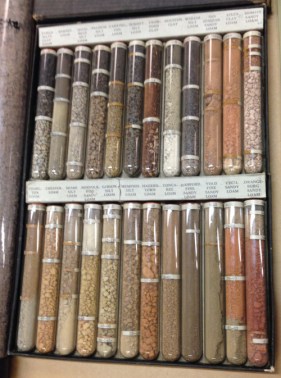
Miniaturized soil profiles from the United States (Van Es Collection)
The inspiration for creating miniaturized soil profile representations that could be collected and used for educational purposes came from a set of beautifully maintained soil profile models at Cornell University in the Van Es Lab (see picture to the right). Although soil monoliths are the gold standard for learning about soils ex-situ, these miniaturized models require less skill, time, and space to produce. Therefore, this tool is accessible for teachers that are introducing soils to their classroom. My vision for a hypothetical collection would be to have an excellent photo of the soil profile along side the miniature representation of the soil profile. In preparation for my second Free Skool Soil Science class, I created a representation of a Langford Channery Silt Loam in Ellis Hollow, Ithaca, N.Y. in a plastic quart container (see below). I represented each 3″ of the real soil profile as 1″ in the plastic quart jar. My first try at this activity provided food for thought about how to improve a miniaturized soil profile model. Like the models in the glass tubes above, it would be helpful to use separators between soil horizons so they are easier for students to identify. In addition, instead of making an arbitrary 3″–>1″ representation, it would be better to sample based on the soil horizons. For example the A horizon should be sampled and be represented by the avg A horizon depth/the total depth of the profile. I also realized that the soil should probably be dried before it’s put together in the model.
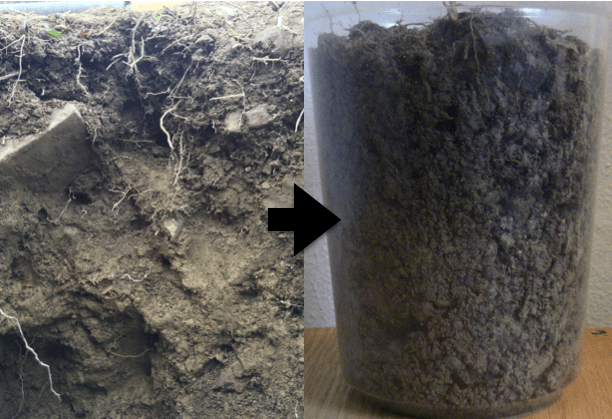
0-18″ Langford Channery Silt Loam Profile from Ellis Hollow, Ithaca, N.Y. (Left) and a 6″ Langford Channery Silt Loam model in a plastic quart jar.
 Soil Joe's Blog